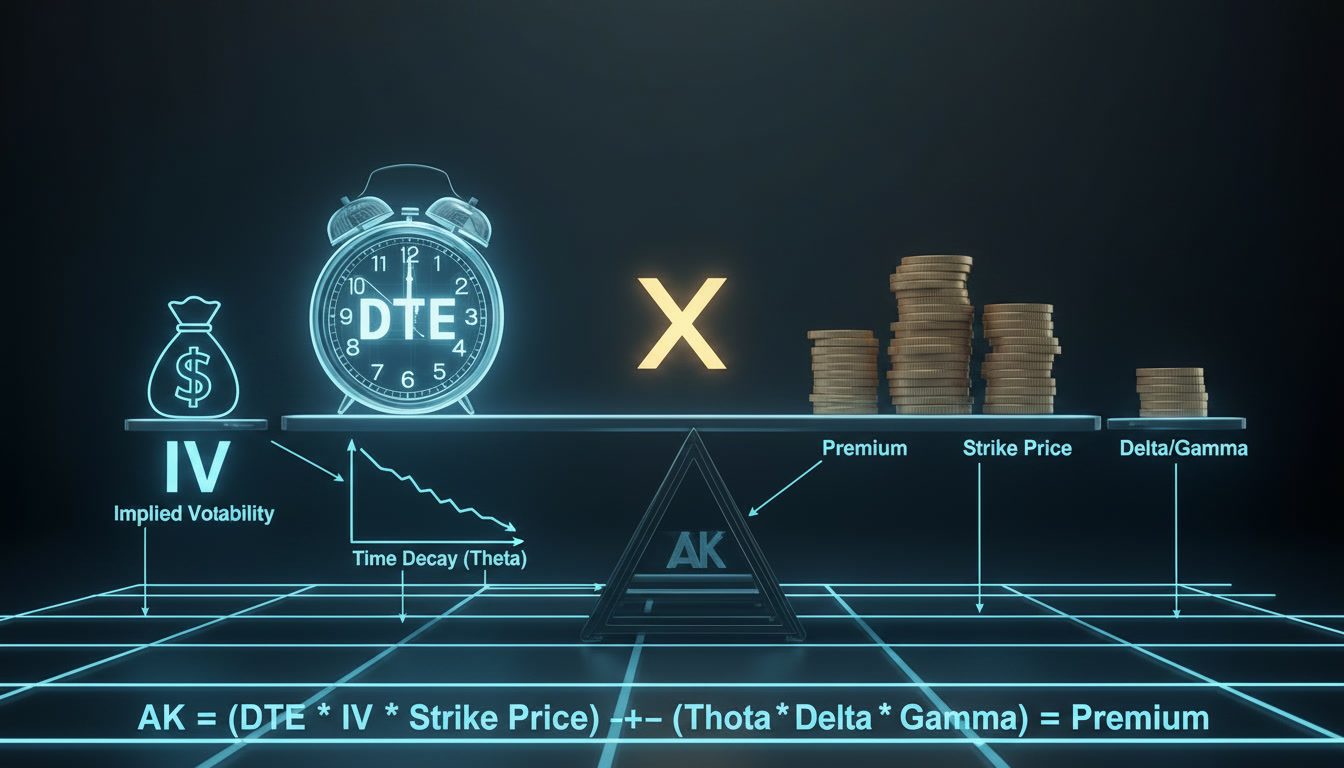
You can run the wheel without ever pricing an option by hand, but three Greeks - delta, theta, and the DTE clock they live on - decide every trade's odds, pay, and terms. Plain-English versions below; no calculus invited.
Delta: your odds and your exposure
Delta is two things at once. It approximates the probability your option finishes in the money - a 30-delta put gets assigned roughly 30% of the time - and it measures how much the option's price moves per $1 of stock movement. Wheel traders mostly use it as a dial: lower delta means fewer assignments and thinner premium; higher delta means richer premium and more shares showing up. The "30-delta wheel" isn't magic, it's a chosen point on that dial - what matters is picking your point on purpose and keeping score at it.
Theta: your daily paycheck
Theta is the dollars an option sheds per day of pure time. As a seller, it's your accrual rate. A short put with $0.03 of daily theta on $1,750 of collateral is paying you roughly 0.6% a month just for existing - before the stock helps or hurts. Theta grows as expiration approaches, which is why the middle of an option's life often pays better per day of risk than the long tail at the start.
DTE: the contract terms you chose
Days to expiration is the lever that shapes both Greeks. Long-dated options have more total premium but lazy theta and more time for the thesis to break. Short-dated options decay furiously but punish you with gamma - tiny stock moves swing your P&L hard in the final days. The popular 30-45 DTE entry window with an early exit is just a way to harvest the steep middle of the decay curve while ducking the chaos at the end.
Vega and the Greeks you can mostly wave at
Vega (sensitivity to implied volatility) matters when IV is extreme - selling high vega into an IV spike is the whole "sell fear" playbook. Gamma explains why expiry week feels twitchy. Rho is for bond desks. For a wheel trader, the working set is delta for odds, theta for pay, DTE for terms, and a journal that records all three on every trade - because the Greeks you chose are only a strategy if you can later check what they actually delivered.